









 June 8, 2023
Overview
The overview analysis shows that for employers in the UK with less than 250 employees, the gender pay gap does not seem to fluctuate in significant difference from 2017 to 2021. This is also the case for employers with a size of 250 to 499, 500 to 999 and 1000 to 4999 employees. Employers with a size of 5000 to 19,999 or 20,000 or more show more significant fluctuation between years.

The overview analysis shows that for employers in Scotland with less than 250 employees, the gender pay gap fluctuates more than in the UK from 2017 to 2021 across all employer sizes.

Sector
The sector section of the report highlights the fluctuation between years in reducing the gender pay gap for part-time employees in the UK and Scotland. There is less fluctuation for full-time employees.
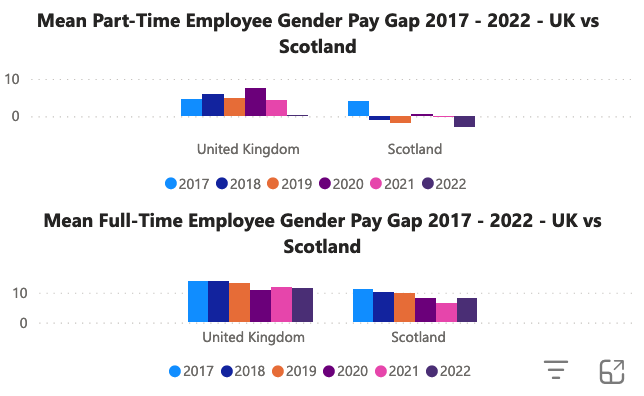
In terms of the median values, for part-time employees, this showed to be significantly positive in favour of reducing the gender pay gap. For full-time employees, this did not fluctuate greatly for UK employees, but for Scotland, 2020-2022 showed a significant reduction.

The mean full and part-time gender pay gap in the public sector gradually decreases. For non-profits, full-time employees see very little change across 2017-2022. For part-time non-profit employees, the gap tends to be small across the timescale. In the private sector, the gender pay gap for part-time employees is low in comparison to full-time employees. However, this is decreasing for full-time staff.

Regarding the median, part-time employees experience a higher pay gap in the public sector compared to full-time. However full-time employees have seen little change in reducing the disparity. Part-time non-profit employees see a lower pay gap than their full-time counterparts. The pay gap in private sector part-time positions is positive towards females and is significantly higher in full-time jobs.

Employer
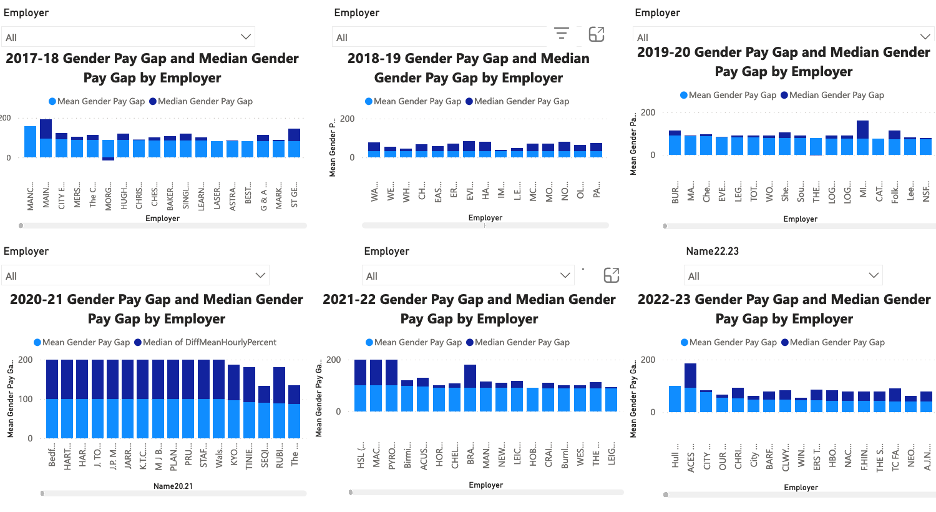
The employer mean and median results fluctuate between employers each year. The median tends to be relatively low each year except 2020-21. Early indications of 2022-23 show a decrease in the mean and median pay gap values.
Age
The disparity for 18-21 and 22–29-year-olds was generally low across all years. For 30-39, 40-49, 50-59 and 60+ the pay gap mean and median values grew across all years.


Full vs Part Time
The gender pay gap mean values tended to be lower for Scotland compared to other regions in the UK for part-time employees. For full-time employees, Scotland was not the lowest region but certainly was more inferior to several different areas.

For the median, this tended to be favourable for females across all years and regions, with a few exceptions for part-time employees. Regarding full-time employees, Scotland appears to have a lower median value for gender pay gaps than other areas.

Industry
The financial insurance industry had the highest average gender pay gap, with the water supply industry having the lowest.

Scotland had the second highest pay gap compared to England, Wales and Northern Ireland, but this was still lower than the UK.


 Prev Post
What do you think?
Show comments / Leave a comment